Earth Day Motion Practice as a part of Park to Park 103rd St. #StreetArts2023 April 27, 2023
Posted by jillsigman in Uncategorized.add a comment

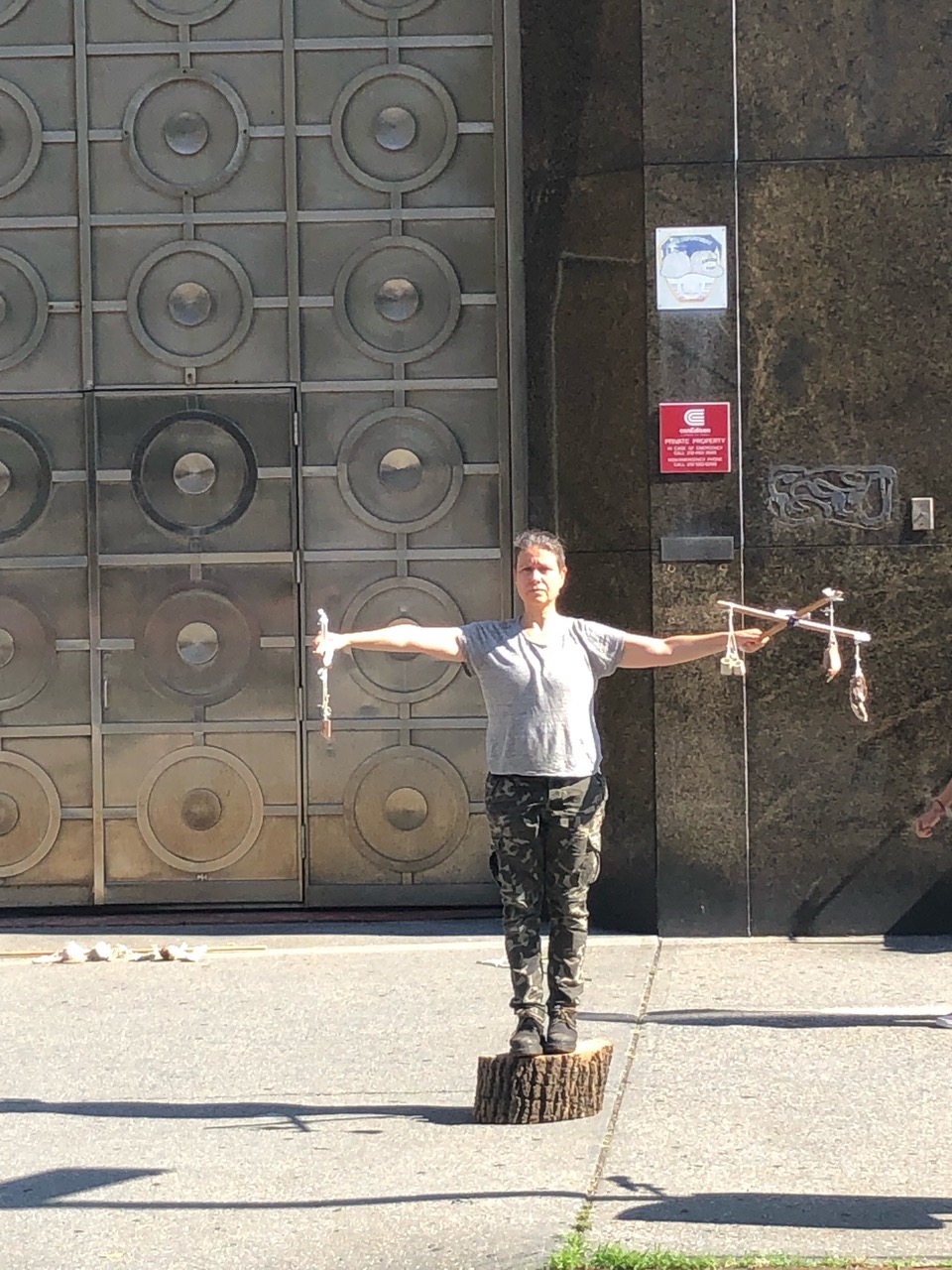
Photo by Carrie Stern
On April 23rd, jill sigman/thinkdance gathered with 10+ movers, witnesses, and passerby for a continuation of the Motion Practice series with a special Earth Day Motion Practice as a part of #StreetArts2023 organized by Park to Park 103rd St. Movers participated in a 1-hour dance improvisation exploring the following questions: What is your relation to the ground? What is your relation to the environment? What is your relation to each other? What is your relation to the climate future you imagine?


Photos by Carrie Stern and Jill Sigman
Motion Practice is an informal series of pop-up public movement events that jill sigman/thinkdance started during the pandemic to facilitate connecting safely and remembering the power of moving together in public space. People are invited to be movers or witnesses, and movers work with a simple movement score that grounds us in connecting to land, to each other, and to other aspects of the site.
On 103rd St. and Broadway, movers interacted with elements of the ground, street trees and plants, nearby chalk drawings, and a few witnesses turned movers. Movers were unexpectedly joined for a part of the improvisation by musician Skip LaPlante who utilized nearby materials like a traffic cone to make sound.


Photos by Merry Aronoff, Jill Sigman, and Carrie Stern
Following the improv, movers and witnesses gathered with Jill Sigman and special guest HK Dunston for wild edible tea and a co-facilitated discussion about climate futures, movement, and making meaning in our lives. HK is an urban planner, climate adaption researcher, and faculty member at School of Visual Arts (SVA) where she teaches a course called Imagining Climate Futures.


Top photos by Merry Aronoff, bottom photo by Carrie Stern includes HK Dunston on the far left
To Mend (version 2) at Amsterdam Eco-Arts Festival December 15, 2021
Posted by jillsigman in Uncategorized.add a comment

On Saturday, September 18th, I was joined by dancers EmmaGrace Skove-Epes and Rishauna Zumberg in Version 2 of To Mend. We performed at the Amsterdam Eco-Arts Festival, a part of Park(ING) Day, an annual global event in which parking spaces are transformed into public places for people and art. This public program was presented by Jody Sperling/Time Lapse Dance and The Columbus-Amsterdam BID and offered informal community planting, a Native New York orientation, dance and music performances, poetry, participatory socially conscious muralling for kids, and family workshops.


To Mend is an iterative durational process of organizing and dancing with ceramics—a meditation on brokenness and how we will put the pieces together anew. It is part-performance part-installation; with care, we arrange a set of ceramic shards that I have made into a shapeshifting instrument that can be danced with and played. Sound and silence, movement and stillness, compose this reflection on slowness, loss, and repair, both personal and structural.
Photos below by Phyllis McCabe (bottom L) and Andrew Ingall (top L and R)




Photos by Phyllis McCabe (L) and Andrew Ingall (R)
To Mend (version 1) occurred on July 31st in Riverside Park with Kirstin Norderval and myself. Version 2 is an extension of the work into a varying site, where grassy ground is replaced by concrete and metal surroundings.

Photo by Andrew Ingall. Rishauna and EmmaGrace hold a sound object made from a long branch. Jill reaches her arms towards the background. A person is walking by as Jill reaches.

Participants reflect on Motion Practice: a pop-up movement event December 26, 2020
Posted by jillsigman in Uncategorized.add a comment

on the hillside late 2020
within a mound of dead leaves
tiny pink flowers
X<•>X<•>X<•>X
“I was very drawn to one old large tree on the hillside and returned to it like an old friend… Beneath it and all the fallen leaves, I saw these delicate pink flowers. They seemed so life affirming in this year of so much death physical and otherwise.”
miriam borne


“Sometimes as I was moving the way a nearby plant seems to move, an urge would come up from within and I’d move the way my human body wanted to move—to unwind kinks and stuck places I usually tune out.”
Sarah


We’re in such a strange moment in time. A moment when community is so necessary yet difficult to feel.
When embodiment within community is often limited to faces on screens.
But to move together.
To respond together.
In our full bodies.
A moment in this moment of feeling full and being full and sensing full.
A moment to connect to reflect to be giddy and somber, to run, lean, vibrate,
and be so very still in the presence of so much stimuli.
A moment to reflect on the where and when we are and the how we got here.
Carolyn Hall

“During my dance, I danced with a tree, imagining my flight. Also, kind of fun, some squirrels came around and danced by my feet.”
G
Motion Practice: a pop-up public movement event with jill sigman/thinkdance December 12, 2020
Posted by jillsigman in Uncategorized.add a comment

On November 29th in Riverside Park, jill sigman/thinkdance gathered with some 25+ movers and passing witnesses for Motion Practice: a pop-up public movement event. Together, we danced for three hours, working through an improvisational movement score focused on relationships to the land, plant life, each other, architecture, and sky. This score has grown out of our live outdoor practice during the pandemic. Movers interacted with the park’s tactile landscape, integrating fallen leaves, branches, trees, fences, plants, and birds into their improvisations. We were connected by phone to another group of dancers on Zoom, all joining the same score in remote locations.


Thank you to everyone who attended Motion Practice: a pop-up public movement event with jill sigman/thinkdance in Riverside Park and on Zoom! Special thanks to Zoom facilitators Krishna Washburn and Stacy Lynn Smith, core dancers Dani Cole, Donna Costello, Carolyn Hall, Paty Lorena Solórzano, and Rishauna Zumberg, and park assistants Beau Banks, Sarah Cooley, and Lorena Jaramillo. Photo documentation by Beau Banks and Lorena Jaramillo.


Motion Practice: a pop-up public movement event was made possible in part with public funds from Creative Engagement, supported by the New York City Department of Cultural Affairs in partnership with the City Council and the New York State Council on the Arts with the support of Governor Andrew Cuomo and administered by LMCC.

Ten Huts Book Events and other engagements November 3, 2017
Posted by jillsigman in Uncategorized.add a comment
OCTOBER 30, 6-8PM
NYU Ten Huts Book Launch & Signing
Performance Studies Studio (#612)
NYU Tisch School of the Arts
721 Broadway- 6th Floor
Tisch Open Arts in cooperation with Tisch Performance Studies and the Tisch Initiative for Creative Research will host this FREE event. I will be joined by performance studies scholar Andre Lepecki who contributed an essay to the volume.
https://tisch.nyu.edu/performance-studies/events/js-ten-huts
NOV 2, 7PM
Princeton Women’s Network and Princeton Association of NYC- an event for alumni
Ten Huts: Seven Years of Building with Trash
A Book Event with Jill Sigman
Advance registration required:
NOV 7, 6:30PM
Movement Research Studies Project:
Interdisciplinary responses to the political moment with Pramila Vasudevan, Piotr Szyhalski, Salome Asega, and Jill Sigman
A facilitated dialogue about the responsiveness of artistic practice to pressing sociopolitical and ecological concerns of our time.
https://movementresearch.org/event/6712
NOV 15, 7PM
Wesleyan University Ten Huts Book Reading– a book reading and launch with Jill Sigman and Ten Huts contributor philosopher Elise Springer.
RJ Julia Wesleyan University Book Store
413 Main St
Middletown, CT 06457 FREE
DEC 5, 7PM
Gibney Dance Center, NYC
Ten Huts: Seven Years of Choreographing with Trash
A Book Event with Jill Sigman and Eva Yaa Asantewaa
At this celebratory event choreographer, interdisciplinary artist, and agent of change Jill Sigman will read from her new book Ten Huts, recently released by Wesleyan University Press. She will be joined by interlocutor Eva Yaa Asantewaa, dance critic, writer and contributor to the volume. The evening will include readings, dialogue, and some special interactive exercises for the Gibney community.
Books will be for sale at most events. You can also order online at:
http://www.upne.com/0819576897.html

Ten Huts is here! October 14, 2017
Posted by jillsigman in Uncategorized.Tags: book, huts, re-purposed, The Hut Project, Wesleyan University Press
add a comment
After years of work weaving together experiences, essays, photos, and diagrams in a process not unlike that of building a hut out of found materials, the book Ten Huts is finally here! It was released by Wesleyan University Press in September and I am proud to share it with you.

Ten Huts documents the creation of eleven (yes, eleven) huts that I built out of waste and performed in in different parts of the world. It includes an artist essay about the project and essays by scholars in other fields — Andre Lepecki (performance studies), Elise Springer (environmental ethics), Eva Yaa Asantewaa (dance), Matthew McLendon (art history), Thomas Hylland Eriksen (anthropology) and a Foreward by Pamela Tatge, Director of Jacob’s Pillow Dance. The book is full color, hardback, with 499 photos and diagrams that show the huts, my creative process, and the many strange artifacts that I used to build them.
The huts are an artistic project that merges performance, sculpture, social practice, and micro-agriculture. Each site-specific hut was made out of hand collected cast-off objects and was the site for performance, ritual, community dialogues, teach-ins, tea serving, growing things, and raising questions about waste management, sustainability, environmental racism, gentrification, real estate, immigration and home. The book Ten Huts shares this process with those who didn’t experience the huts directly.
You can order Ten Huts here:
http://www.upne.com/0819576897.html#
For 30% off this Fall, you can use the discount code: WUP30

What can dance index? [a meditation after Weed Heart] October 20, 2016
Posted by jillsigman in Uncategorized.add a comment
What does dance know about something? Can dance lead us to new knowledge? Not as a representation of labor, but the impact of that labor on the viewer and on the situation in which it is placed.
How can a dance be indexical? How can the act of dancing without content-based explanation, as a tool in and of itself, point to what is happening in the world?
In Weed Heart, Jill Sigman just made a piece where she showed and told. She told us her relationship to weeds, she danced what it is to be a weed. She told us how weeds, slavery, the commons, and the financial industry all zenithed at the very spot where we sat and drank weed tea and soup, and watched her dance. Then we walked outside and looked at the weeds above the African Burial Ground nearby.
She didn’t tell us what she was dancing “about.” Rather, she danced through these issues, our situatedness in relation to them, and her feelings about them. She showed us what her research did to her body, she was analyzing and reflecting on her body as movement. She didn’t simply “wear” the issues on herself, applique-ing them for the purpose of the performance.
I didn’t feel a duality in mind and body while watching. She did explain to us what she had been thinking about before dancing. So there was an “about-ness” to the piece as a whole. But the dancing did something. Then she took us outside and showed us something: the residue of history in the weedy Paulownia tree, that history that her dancing body-self was thinking through.

A long time ago, I wrote about dance as a reflexive capability in a ritual-based society I visited: a passive/active, individual/communal way of simultaneously reflecting upon and enacting identity, history, culture. I can’t help but return to this idea and wonder how it might apply to experimental performance. What is the dance doing, I ask.
Sometimes it does something. Sometimes it is a visceral, driving force of emotion and experience and humanity.
Sometimes it shows something. It is shapes and colors and an art work. Sometimes it is indexical of its own references, pointing back to the very relegated cultural influences that made it itself. Or to other more well-known cultural references.
I wonder how we could make a wholly meaningless dance, which delves so far into its own meaninglessness it implodes—not physically, but rather, it eats itself, crumbles under its own lightness and apathy.
But then I wonder if a whole storm of things could happen from dance. How it could literally carve space in the body of the witness without any references or with references that are eclipsed by its in-the-moment meaning making.
A dance could go further into and out of a person all at once. Catalyzing reflection while making the room bigger, making the situatedness of the Dance or the Piece go beyond its own self.
Jill took us beyond the dance and beyond the self. But the dance was also itself: as powerful and weak, as unstoppable and ephemeral, as dying and eternal as it always was.
And yet it was never “about her,” or even more simply, a dance about the social history of weeds.
My current questions about what dance can index:
Can a dance point to Korryn Gaines? Without being a comment on her, but somehow being with her?
Can it point to my mom and dad? To a social and class history that may be invisible on the surface my body, but that could be unearthed through moving?
Can it point to invisible histories?
–Lorene Bouboushian, 2016
Lorene Bouboushian is a dancer, performance artist, and educator originally from rural Texas, who utilizes “self-exposure and vulnerability in real, risky ways” [CultureBot, 2011] and produces “thought-provoking commentary on social limits” [Minneapolis Star Tribune, 2016]. Her work ranges from formal solos, to intimate duets, to site-specific group collaborations. Lorene’s teaching practice is integral to her research; she has traveled the world teaching interdisciplinary performance workshops. She also regularly teaches healing arts classes at numerous public schools in New York City. She has collaborated with Social Health Performance Club, Panoply Performance Lab, and musicians, dancers, and performance artists across the US. www.lorenebouboushian.org
Some press about Weed Heart October 6, 2016
Posted by jillsigman in Uncategorized.add a comment
jill sigman/thinkdance presents “Weed Heart” at Gibney
by Eva Yaa Asantewaa (Infinite Body)

Unruly.
That word often crops up when we talk about weeds.
And about certain people.
I’ll use it here to describe both the artist Jill Sigman (jill sigman/thinkdance) and what she has wrought at Gibney Dance Center: Agnes Varis Performing Arts Center as choreographer and as Gibney’s first Community Action Artist in Residence.
Her project, Weed Heart, is an unruly yet sociable thing of sculptured plantings, tea servings, soup servings, community conversations, free-ranging ideas, music and movement in intimate space. It willfully sprawls from Gibney’s gallery lounge area to its tiny ground-level Studio A and, ultimately, beyond the center’s front door.
Weed Heart is both a cozy, rather retro (think: hippie era) installation, a commons where anyone can drop by and hang out (the gallery lounge), and a performance where only a little over thirty onlookers can fit (Studio A). At the evening performance, those thirty or so get soothed by a weedy brew of tea, light and delicious red lentil soup made by Katrina De Wees and luminously textured electronic and vocal energy from composer Kristin Norderval. Seated in a single ring around the space, those thirty or so observe an abstract representation of the path that Sigman took–from earnest seeking and bewilderment to soul-felt awareness–as she sought to learn what common weeds can teach her.
How they communicate with themselves and, potentially, with us. How they survive. How they foster healing. How cultures have regarded and interacted with them over time. How our disdain for weeds parallels our similar ignorance about humans we consider to be unlike ourselves and less worthy.
Eye on Dance

Of the tiny tidbits, sweeping issues, and overarching ideas in Jill Sigman’s Weed Heart, the most effective convergence is plant conversation. Sigman sets up Gibney Dance Center’s downtown space appropriately for audiences to take up the practice. On the second floor, pillows intersperse with plants. At once a meeting ground, meditation center, and library, one easily hears the sheer presence of organisms used to being chopped away. Tracing the dignified history of plants we have learned to consider pests, Sigman preps us to tackle analogous issues of racism without diminishing the botanical content of her metaphor.
Downstairs in the Agnes Varis Performance Lab, doors open to a hanging garden: a fishing cage sheltering bundles of sprouts in soil-filled t-shirts, ruined siding perfectly arced to cradle grass, and a bedframe holding more bundles in its springs. Welcomed with tea brewed with a weed once known as loveage, we connect biologically to the performance’s elements.
Though wearing a large leaf as a mask, the proceeding fiery accumulation of articulations is the same person who greeted us with a cup of tea. Sigman lightly traces a circle, between a jig and a spar. Her weight gradually increases, feet widen, and chest drops to slowly descend a wall, stiffly planked for the duration.
Impressions of Jill Sigman/thinkdance’s “Weed Heart”
by Erin Bomboy (The Dance Enthusiast)

New York looks to be a city constructed almost entirely from manmade stuff: steel, concrete, glass, towering ambition. Even the places and spaces for nature display the imprint of humans. Along the city’s grid, the pristinely manicured lawns of parks intermingle with tidy flowerbeds edged in wrought iron. In the battle between man versus nature, man seems to have won.
But look again.
Weeds sprout from cracks in the sidewalks, and trees push forth from the asphalt. This flora reaches toward the sky, where the sun doesn’t discriminate. Our control over nature is, perhaps, born of illusion rather than reality.
In Jill Sigman/thinkdance’s Weed Heart, she offers an impassioned meditation on observation and discernment. Part installation, part traditional dance piece, and part celebration, Sigman reframes the weed, unloved and unwanted, into something worthy of respect and consideration.
Weed Heart Brain Trust September 22, 2016
Posted by jillsigman in Uncategorized.add a comment
My tremendous gratitude to the Weed Heart Brain Trust, a group of inspiring people who engaged with me in small group and individual conversations about the social, political, and ecological dimensions of weeds, and generously shared their thoughts and knowledge:

Carolyn Hall
Darryl Hell
Marie Viljoen
Jeremy Griffin-Jackson
Hadar Ahuvia
Skye
Ellie Irons
Aviva Geismar
Joanna Rotkin
David Ciepley
Jan Mun
Chelsea Adewunmi
Edisa Weeks
Larissa Sheldon
Lena Struwe
Samantha Harvey
Ricarrdo Valentine
Maria Bauman
Kristin Norderval
Severn Clay
Moira Williams
Katrina De Wees
Siobhan Burke
Marguerite Hemmings
Corinne Cappelletti
iele paloumpis
Christopher Kennedy
Charmaine Warren
Athena Kokoronis
Irene Siegel
Eva Perrotta
Tei Blow
Marjani Forté Saunders
Eva Yaa Asantewaa
Talvin Wilks
Jaamil Olawale Kosoko
Nonkululeko Tyehemba
Demetrius Eudell
Bill Johnston
Michael Frazier
Radhika Subramaniam
Elyse Desmond
Craig Peterson
Chris Schimpf
Kara Gilmour
Dwayne Dash
Nora Alami
Niya Nicholson
Beth Silverman Yam
Asya Robins
Julia Vickers
Margaret Tudor
Kelsey Rondeau
Yasemin Ozumerzifon
Serigne Mbacke Mbaye
An Overture, for Weed Heart September 4, 2016
Posted by jillsigman in Uncategorized.add a comment

What is a weed heart? Is it a thing, a way of being, a sense of earthly compassion, an appendage, a transplant? Is it an organ with the power to heal us or something that beats out our existence? In Jill Sigman’s practice, it has been an intermedia of readymades, communal meals, public conversations, small discussions, weed walks, workshops, and tea servings, unified by thematic concerns of resiliency, toxicity, disposability, environmental justice, marginalized spaces and marginalized people. The performative happening of dance, video, sprouting readymades, and foraged fare underscores the spatial and sensory dimensions of Weed Heart as a project that changes how we taste, touch, see, smell, and hear the weedy spaces around us.
When we see Sigman at the start of Weed Heart, she appears as if between weed and woman. A mask of a single, palm-like leaf covers her face, and her head is adorned with an overgrowth of climbing, shaking weeds. The headdress may aesthetically call to mind the wildlife masquerades of Nigeria (of Obinagu, the Igbo deity of the forest), Germany (of the Maimann of Greenman’s Day), or Switzerland (of Le Noirmont, where men dress up as fir trees), but Weed Heart is not an act of masquerade. It only engages in masquerade theoretically, in a Bakhtinian world-upside-down way — meaning that weeds, which are categorized as alternately useless, invasive, and inanimate, are here elevated to the nexus of significance, resiliency, and life. It is the exploration of this liminal space between matter and man, heightened by the cues of masquerade, that contextualizes the performance not as representation, but as a kind of secular ritual. With record-high temperatures and the widespread overuse of pesticides, Weed Heart offers rituals for a future that is fast approaching.
Ritual is a preparation for things we cannot see, those things on future’s horizon or in our ancestral past. It articulates and defines unfamiliar phenomena so that we can absorb them, mentally and physically. It can be a request for otherworldly intervention or for powers we ourselves don’t have. But most of all, it’s a transformation — it’s ritual that makes the incomprehensible real, and into something living amongst us.
Ritual heightens the role of the audience. It asks that the audience be active participants — something that already happens on the neurological level, for simply in the act of observing, our mirror neurons are firing as if we are doing what we are watching. It asks for our engaged observance because without the witness, the ritual cannot succeed — and thus begins an invitation to the audience to a joint foray into creating and holding this space. This orientation towards ritual situates Sigman’s dance amongst a new wave of choreographers like Luciana Achugar, iele paloumpis, Tatyana Tenenbaum, and Larissa Sheldon, for whom ritual constitutes a mode of choreography.
Many of us move about the city with a virtuosic ability to filter out minutiae and irrelevance, but don’t consider how these categories were formed — how we decided what was without use, worth, or value. Sigman’s call to go outside, to turn to the weeds, changes our scopic sense of the urban landscape — looking down to the low terrainline to distinguish between the mugwort or lamb’s quarters that outline the borders of the sidewalks. It sharpens our senses and re-members the body — it takes apart and puts back together our urban(e) sense of spatial awareness. In Weed Heart’s recontextualizing moves, the mundane, the useless, and the forgotten is re-evaluated, and re-considered — a move that changes how we look at, touch, and even taste the eruptions of green plants that permeate the gray plans of our geometric city. In a concrete space, the growth of the organic becomes heroic.
The dance springs out of an accumulation of the ways Sigman has been living with these plants — the way they have changed how and where she walks in the city, the labor of nurturing them in the extreme weather of NYC, the durational moves of being “in the weeds.” All these repetitive motions — of weed-walking, of harvesting seeds, of planting, of tending, of watering, of transporting — accumulate in the body. In many ways, this dance is the culmination of these accumulations.
Sigman dances with a weedy antenna reaching skywards, as if intercepting messages from plants, or tuning in to the World Wide Wood, the underground hyphal network that connects plants through mycorrhizal fungi, allowing plants to share resources and send warnings to one another. Sigman lies, body prostrate to the ground, as a low sound emanates from her throat. Composer and vocalist Kristin Nordeval joins her voice to Sigman’s and crystalizes the swell. Like the rings of a Tibetan bowl, her voice encircles Sigman’s, striking flickers of overtones. Nordeval plays a makeshift orchestra of found objects, projecting her voice through a metal tube, which, like an industrial divining rod surveying the ground, sounds out what lies beneath. Nordeval’s exquisite soundings accompany the dance with a focus that is rigorously meditative and nourishing.
A diversity of weeds, sprouting out of readymades, are choreographed in the performance space — as tea, as soup, as messenger, as appendage. Performer Katrina De Wees joins Sigman in a section of the dance with herbaceous, robustious bundles that resemble organ-like shapes. Carried in the bough of De Wees’ arms, the bundles are placed on Sigman’s body as a kind of trans/plant. Between De Wees’ steady carriage and Sigman’s grounded form, the dance slows and sediments, akin to a sculptural act.
Sigman’s movement is bookended by videos that impart some of the themes and intentions behind the work. Sigman’s use of video subverts selfie culture — it’s not aspirational, nor is it Narcissus’ glass — but inhabits old ways of storytelling and folklore. You can hear elements of Vladimir Propp’s heroic quest in her search for a way to heal her father’s heart in consort with the loveage weed in her first video. The weed operates between medicinal and metaphoric healer, as if nodding to the Doctrine of Signatures (Paracelsus’ idea that the plant world provides all that we need to heal our bodies) — all you need is lovage. The videos also frame the performance in terms of continued conversation, not just with weedy upstarts like lovage and paulownia, but the activists, farmers, dancers, artists, and scholars who have been a vital part of Sigman’s process. The videos feel like notes from the field — impressions from the peripheries (the abandoned lots, the “wastelands”) that Sigman has inhabited physically in the making of this project — and now Sigman is here before us, back from the field, her face overgrown with plant life, post-verdant transformation. The videos allow Sigman to play with these tensions of the ancient and the contemporary, on-stage presence and remote distance, the face’s naked vulnerability on the video screen and the stoic warrioress with mask-obscured face before us.
With the penultimate video’s reference to the site we find ourselves on, the dance excavates histories of the ground beneath us — an incantation to recall what came before property, enclosures, and real estate in NYC. As Richard Mabey writes in Weeds, weeds have trailed our movements — the way wagons broke up the ground while traveling westward (leaving a trail of Broadleaf plantain, or White man’s footprint), the Gallant-Soldier (a posy) that grew out of WWII bomb sites in the UK, and the plants that travelled in ballast and arrived on NYC docks, revealing trade routes. The presence of weeds is evidence that the ground has a stubborn memory, particularly in matters of human disruptions.
Finally, Sigman’s performance cannot be separated from this historical moment. A moment in which a gardener for the NYC Parks Department named Eric Garner can be deprived of breath on a city sidewalk for selling loose cigarettes. A moment in which the language that modifies or couples with weediness — words like invasive, uprooted, foreign, immigrant, border — have been used to naturalize the idea of a monocultural nationhood and impossible walls. Weed Heart is a reckoning with the systems of value that underscore all of these events — making us look not just at space, but at life, anew.
— C. Adewunmi
New York, September 2nd, 2016
 | Get Feed
 Dispatches from